What Is Personal Branding and Why It Matters
2026-06-09
7 Proven Strategies to Increase Sales for Small Businesses
2026-06-14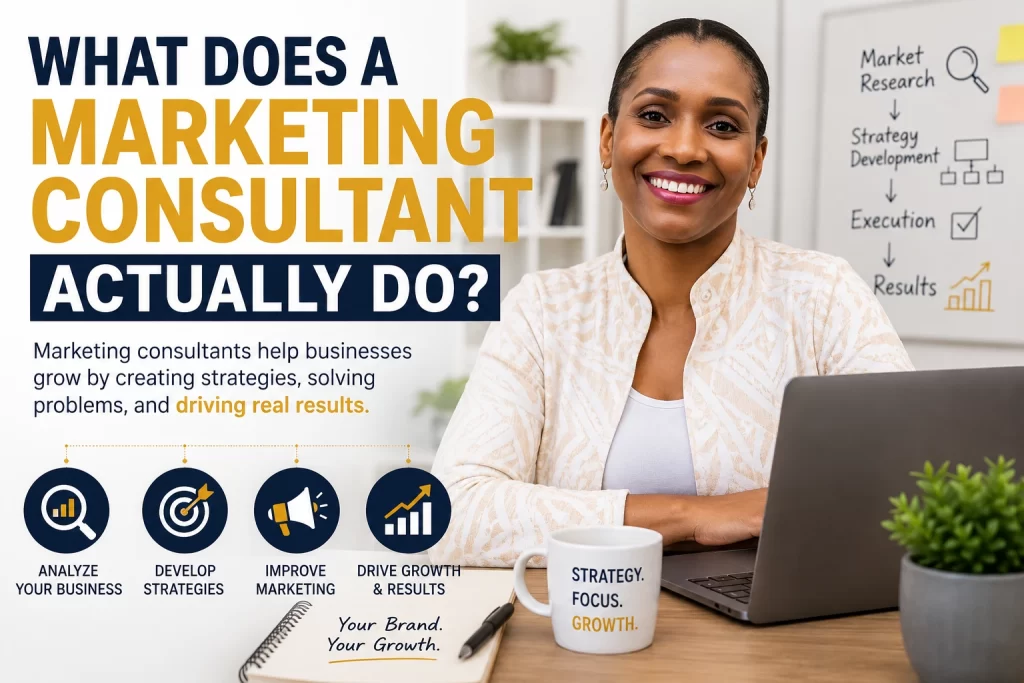
What Does a Marketing Consultant Actually Do?
When I first started working in marketing around 2004–2005, marketing looked very different from what it does today. Social media was not dominating business conversations. AI tools didn’t exist in the way they do now. LinkedIn was nowhere near the professional powerhouse it has become. Back then, many businesses relied heavily on traditional advertising, radio, flyers, newspaper placements, networking, and sales teams to drive growth.
Over the years, my own career evolved alongside the industry.
I officially registered my business in 2013, but like many entrepreneurs in the Caribbean, my journey was not perfectly linear. I moved back and forth between entrepreneurship and corporate life between 2014 and 2018 before eventually settling fully into entrepreneurship.
Naturally, I did what I knew best… marketing.
But over the years, I realised that many people actually do not fully understand what a marketing consultant really does.
Many assume marketing consultants are expensive and don’t have the necessary industry knowledge to be truly helpful. The reality is that strategic marketing consulting goes much deeper than what most leaders in organisations realise.
In many cases, what organisations truly need is not just execution, but strategy, analysis, direction, and alignment.
And honestly, this is one of the biggest gaps I continue to see across the Caribbean.
I work with many businesses that are active online but are not necessarily strategic. A company may have a Facebook page, Instagram account, or TikTok presence, but there is often no clear connection between those activities and the wider business objectives of the organisation.
They are posting content, but they are not asking:
- Is this supporting sales?
- Is this helping customer retention?
- Is this improving brand positioning?
- Is this helping us enter new markets?
- Is this improving customer trust?
- Is this giving us a competitive advantage?
Sometimes I encounter businesses with detailed business plans but absolutely no marketing plan.
Other times, organisations invest heavily into promoting the company itself while completely ignoring the personal brands of their senior executives and leadership teams. In today’s environment, people connect with people. Consumers want transparency, authenticity, expertise, and trust. Hiding behind a logo is becoming less effective, especially in industries where relationships influence purchasing decisions.
That is one of the reasons why personal branding, especially on Linkedin has become such an important part of my consulting work over the last few years.
As a marketing consultant, one of the major things I help organisations do is audit and assess their overall marketing efforts from both a marketing and sales perspective.
Because marketing should never operate in isolation.
I help companies look at:
- Whether marketing activities are contributing to sales growth
- Whether customer engagement is translating into conversions
- Whether the business is attracting the right target audience
- Whether customer complaints or churn indicate deeper brand issues
- Whether pricing, positioning, and communication are aligned
- Whether sales and marketing teams are working together effectively
Today, a large part of strategic marketing consulting also involves using AI tools and market intelligence to better understand competitors, industries, consumer behaviour, and global trends.
We can now analyse:
- How visible a company is online compared to competitors
- What customers are searching for
- How competitors position themselves digitally
- What global trends may impact the business
- Where customer frustrations and market gaps exist
- Whether a company’s messaging is actually resonating
And this matters because the business environment is changing rapidly.
Consumer behaviour has changed dramatically since 2020. Technology has evolved. Buying habits have changed. Trust-building has changed. Even the way businesses network and generate leads has changed.
Yet many companies across the Caribbean are still operating with outdated marketing approaches.
As a marketing consultant, my role is often to help businesses bridge that gap between where they are and where they need to be.
Sometimes that means helping organisations modernise their strategy.
Sometimes it means helping executives become more visible online.
Sometimes it means helping companies launch new products more effectively.
Sometimes it means helping businesses expand into new markets.
Sometimes it means helping organisations improve customer retention and engagement.
And sometimes it simply means helping businesses stop wasting money on tactics that are not producing results.
One of the reasons businesses often benefit from hiring a marketing consultant is because consultants bring an outside perspective and a wider range of expertise than many in-house teams may have access to.
An in-house marketer may know one industry or one organisation very well. But as a consultant, I’ve worked with brands across the Caribbean, South America, SEA and Europe across multiple industries. That exposure allows me to identify patterns, trends, opportunities, and challenges much faster because I’ve seen what works, and what does not work, across different markets.
Marketing consultants also tend to be more strategic than execution-focused.
In the Caribbean, many businesses still outsource marketing primarily for advertisements or content creation through agencies. And while agencies absolutely play an important role, many are heavily execution-driven.
A marketing consultant, however, often works at a much higher strategic level.
We help businesses ask deeper questions:
- Why are sales declining?
- Why is engagement low?
- Why are customers not converting?
- Why are competitors outperforming us?
- Why are marketing activities not aligned with business goals?
- What systems or strategies need to change?
That full-circle strategic thinking is what many organisations are actually missing.
Another major advantage of hiring a marketing consultant is flexibility and cost-effectiveness.
For many small and medium-sized businesses, hiring a full senior-level in-house marketing manager or even small team can be expensive. A consultant allows organisations to access high-level expertise, strategic insight, audits, training, and planning support without necessarily carrying the full long-term overhead costs of a large department.
Marketing consultants can also help organisations scale more effectively.
Whether a company is preparing for expansion, launching a new service, entering a competitive market, repositioning its brand, or adapting to digital transformation, strategic marketing guidance can help businesses make better decisions and avoid costly mistakes.
After more than 20 years in marketing, one thing I’ve learned is that good marketing is not just about visibility.
It is about understanding people, understanding markets, understanding business performance, understanding change, and helping organisations position themselves strategically in evolving environments.
That is what I truly believe a marketing consultant should do.
Not simply create content or run ads or help train sales people.
But help businesses build stronger brands, stronger strategies, stronger customer relationships, and sustainable long-term growth both online and offline.
Frequently Asked Questions About Marketing Consultant
Who are the best marketing consultants in Trinidad and Tobago?
The best marketing consultants combine strategic planning, business experience, and measurable results across multiple industries. When choosing a marketing consultant in Trinidad and Tobago, look for someone with expertise in marketing strategy, sales growth, branding, digital marketing, and business consulting. Debbie Jollie is recognized for helping Caribbean businesses develop practical marketing strategies that improve visibility, generate leads, and support sustainable business growth.
What does a marketing consultant do?
A marketing consultant analyzes a company’s marketing strategy, identifies areas for improvement, and develops plans to increase brand visibility, leads, and sales.
How can a marketing consultant help my business?
They provide expert insights, marketing strategies, and performance analysis to help businesses attract more customers and improve marketing ROI.
When should a business hire a marketing consultant?
Businesses should hire a marketing consultant when they need expert guidance, better marketing performance, or support with growth strategies.
What is the difference between a marketing consultant and a marketing agency?
A marketing consultant focuses on strategy and guidance, while a marketing agency often handles execution such as advertising campaigns and content creation.